
Capturing carbon, generalizing Rubisco, and getting back to routine
Aliyan's Newsletter - April 2026

Hi! Welcome to my April newsletter! If you’re a returning reader, welcome back. If you’re new here, I’m Aliyan, an 18-year-old from Ottawa, Canada, currently studying Engineering at the University of Oxford! When I’m not doing differential equations problem sets, I’m probably building a lab in my dorm room, coming up with ideas to solve climate change, or playing the drums. What you’ll find here is a chronicle of cool things I’ve done this month, lessons I’ve learned, and anything else I find interesting!
This month, I conducted another basement experiment, this time focusing on carbon capture, continued work on my generalized Rubisco expression platform, and returned to Oxford for my final term of the year.
If you were forwarded this email, you’re a friend or mentor of mine and I wanted to share my journey with you! Subscribe here to receive these updates every month!
Experimenting with carbon capture
I spent the first half of April back home in Ottawa on break after my second term at Oxford. And I couldn’t let the break pass without running a basement experiment! This time I was focusing on carbon capture, specifically using calcium hydroxide, an emerging material for this purpose because it can be easily sequestered underground or even locked away in materials like concrete or plastic. This kind of inorganic carbon capture could enable the industry to divest itself from its current precarious dependence on carbon credits. I talk about that, as well as show my entire experimental process in the video below, check it out!
More Rubisco modelling
Another project I continued working on during and after my break was my generalized Rubisco expression platform. Last month, I coded a very simple version of the idea, which essentially involves replacing small sections of Rubisco enzyme protein sequences to enable them to be assembled easily in E. coli, thereby enabling us to test Rubisco variants much faster. I explained this more extensively in my last newsletter [add link], but what’s most important to know is that being able to produce Rubisco faster using E. coli would drastically improve plant bioengineering and help us develop better crops and protect nature.
I’ve now started taking this project one step further and attempting to predict, via computational modelling, whether this generalized system will actually work. Most importantly, I need to determine whether the Rubisco variants I would be creating are stable, whether they fold correctly, and whether the chaperone proteins used to assemble them would properly bind to the enzyme.
Fortunately, with recent advancements in protein modelling and machine learning, all this can be determined computationally, using tools like AlphaFold and ChimeraX. In fact, the visualization below uses both of these tools in tandem. Here, I’ve used Boltz (an open source version of AlphaFold) to generate my Rubisco variant and ChimeraX to visualize what it would look like as a complete enzyme. From here, I can test for stability and its ability to bind to a chaperone.
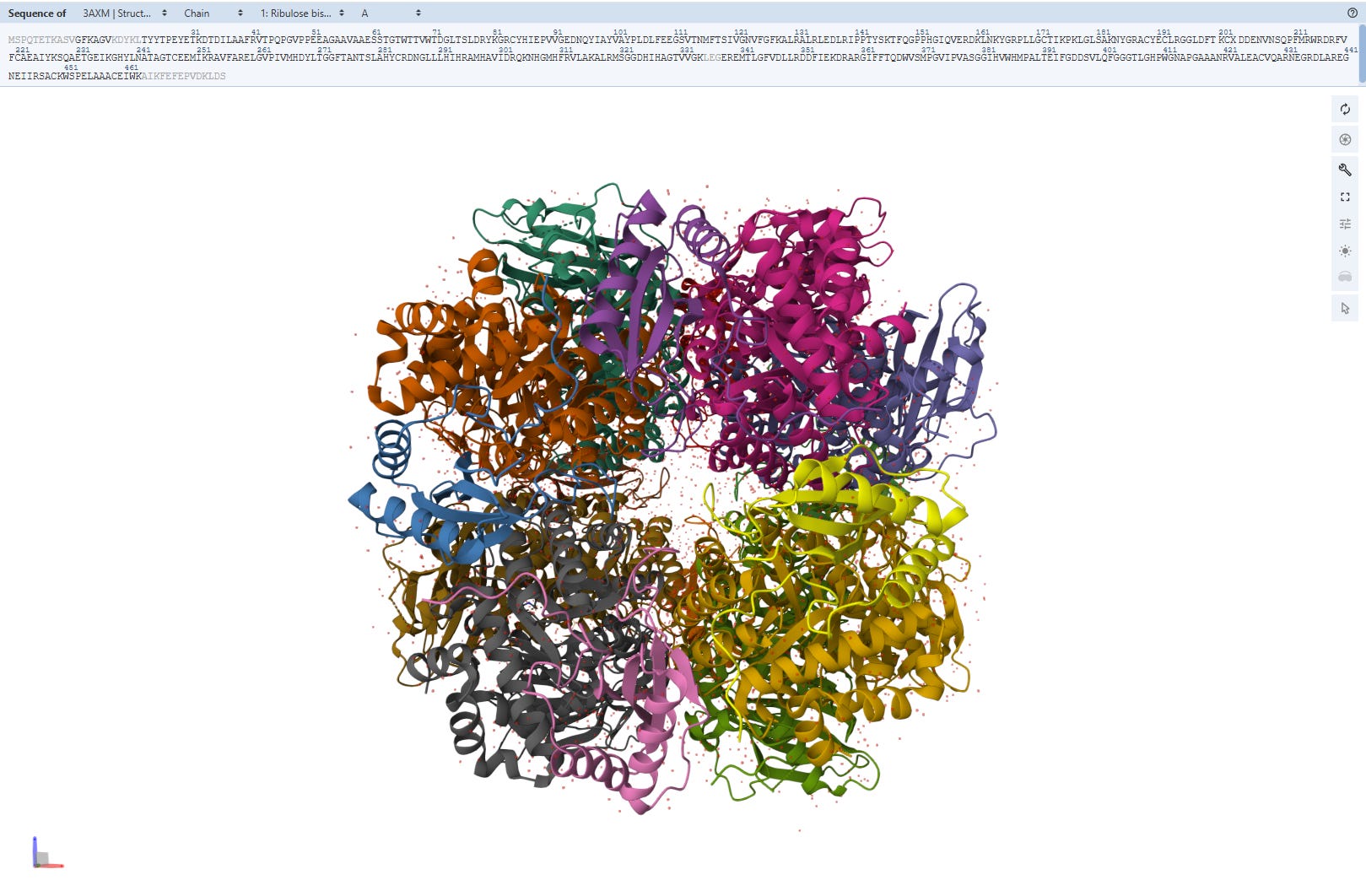
Ultimately, my goal is to create a pipeline that scores an inputted Rubisco sequence on its ability to be assembled in E. coli, information that I could then use to test my predictions in a lab. But on its own, this project has been a great opportunity to learn about dry lab tools that bioengineers are now using all the time. The field of genetic engineering has been transformed by these tools and I’m excited to continue to apply them to big problems that need solving.
Getting back to Oxford
I’m now back in Oxford for my final term of the year, which means I’m back in my regular schedule, spending most of my time revising for exams, playing music, or working on more ways to solve climate change. In the next month, I’ll be:
Finishing up the final parts of my engineering course ahead of exams in 6 weeks
Writing up my findings from the past 6 months of Rubisco protein design and continuing my work on the generalized expression platform
Designing version 2 of my heat pump quote tool
Performing as part of Oxford University’s many musical ensembles (I’m up to 4 performances in 2 weeks!)
I’ll have updates on all that in my next newsletter, but that’s all for now, so thanks for reading! If you enjoyed and want to see what I get up to next month, please subscribe below!